
So… you want to grow closer to God, but you don’t know where to begin? There is no shortage of Bible study resources out there that promise to help you mature in your faith, but what should you really be looking for? Let’s take a look at the TOP 10 Must-Haves!
- The resource should prioritize God.
We exist for the Lord; He does not exist for us. Resources that are people-centric diminish the thrust of the Bible’s message—namely, that everything is ultimately about God, and His primary objective is His own glory. A solid resource must start with this perspective. It is a non-negotiable.
- The resource should emphasize dependence upon the Holy Spirit.
We need the Spirit to help us understand the Bible, interpret meaning, and make appropriate application to our lives. The Holy Spirit is called the Teacher, who will guide us into all the Truth (John 16:13). For this reason, a solid Bible study resource does not tell you what the Bible says. Rather, it will gently point you to discover meaning through the help of the Holy Spirit.
- The resource should point you to what the author intended to say.
A common error in Bible interpretation is to emphasize the reader instead of the author. All care must be taken for the reader to avoid imposing meaning upon the text, which is challenging since we unthinkingly filter what we read through our own world perspective and biases. Therefore, a solid Bible study resource will point you to discover what the author meant to convey. (This is called “authorial intent.”) Because authorial intent is the only accurate meaning of a given text, there is only one correct interpretation. An accurate understanding of Scripture suffers when ignoring authorial intent.
- The resource should ground meaning in context.
Many verses are misinterpreted because they are lifted from their context. Context includes the following:
*Textual context — Of course, this includes the verses just before and after a verse or passage. In addition, a solid Bible study resource will also promote awareness of the entire chapter (and even book) where the verse/passage is embedded.
*Cultural context — It is helpful to know how the original audience would have understood the writer’s meaning. Traditions and customs (especially religious ones) affect one’s worldview and perspective. Therefore, the author’s cultural context must also be considered.

*Historical context — It is helpful to know the political climate and what events were transpiring at the time the book was written. For example, learning about Roman rule throughout the world in the first century is critical for interpreting many New Testament texts. Similarly, familiarity with the Ancient Near East and various secular dynasties yields a more accurate understanding of the Old Testament.
*Linguistic context — The Bible’s meaning is also affected by the context of the original languages—primarily Hebrew and Greek. A solid Bible study resource will encourage consulting a Strong’s concordance and lexicons to enrich understanding of key words in the text. In the same way, referring to multiple Bible translations can develop a more complete understanding of a given passage.
- The resource should emphasize Truth, not our feelings.
As we seek to know the Scriptures, so that we can better love and worship God, we do well to look for study resources that insist on learning truth over seeking experiences. Many people have been led astray by books and teachers that appeal to their audience’s emotions. Feelings can be deceptive, and personal experience prioritizes the person rather than the Lord. Our objective in Bible study should be discovering God’s character, attributes, and ways through what He has revealed in the Scriptures. After all, it is Truth found in the Word that sanctifies (John 17:17).
- The resource should promote personal application.
While the Bible is certainly intellectually stimulating, and there can be much excitement in learning new information, ultimately, the goal of a good Bible study is to move knowledge from the head to the heart. In other words, what we know about God and His Word should affect the way we think and feel, our desires, and our behaviors. In other words, the point of Bible study is to change us from within, and in a way that shows from without.
- The resource should draw applications from biblical principles.
A common error in Bible study is to start with an application, and then (using the Scriptures as a kind of ransom note), piece together “proof texts” that support a preconceived notion. We must always, always, always start with the Bible. Ask: What is a passage clearly teaching that stands apart as a universal truth to be believed and obeyed in all generations and cultures? From this principle, we then formulate the best course of action to put this Truth into practice. That is, to LIVE the Word.
- The resource should lead to self-examination and practical repentance.
A solid Bible study resource provides thought-provoking, open-ended questions that cause you to examine your heart, and especially your motivations. If the goal of Bible study is to effect change in our lives, then we need to allow the Word to “read” us as we read it. Helpful Bible study resources aim to point you to honest assessment regarding where you need to repent of sin and grow spiritually.

- The resource should encourage praying for growth.
A solid Bible study resource will help train you to mature in your prayer life. So many “prayer meetings” focus on asking God to fix our circumstances. While we should certainly take our needs and concerns to God, the spiritually mature recognize that our circumstances are meant to grow us in our relationship with the Lord. The Scriptures help us to identify our spiritual deficits, and prayer acknowledges our dependence upon God as the source to effect this needed change in our hearts and lives. What’s more, as we see Him transforming our thinking, desires, and behaviors, our prayers are increasingly filled with gratitude for the evidence of His Divine fingerprints on our lives.
- The resource should require time and diligent effort.
While devotional books can make for a quick encouraging or inspirational boost, when looking for Bible study resources, we must first acknowledge the need for materials that require more from us as learners. A good Bible study resource will require more than a few minutes each day and real commitment and diligence to know the Lord more intimately. God wants us to love Him with all our hearts, souls, minds, and strength (Mark 12:30). And He is worth the investment. There is no short cut to a deeper relationship with Him.
In closing, if you sincerely desire to grow closer to God, you MUST invest in knowing His Word for yourself. It is not enough to passively receive information in church or read books written about God. The Lord wants to meet with you one-on-one through the pages of His living Word.
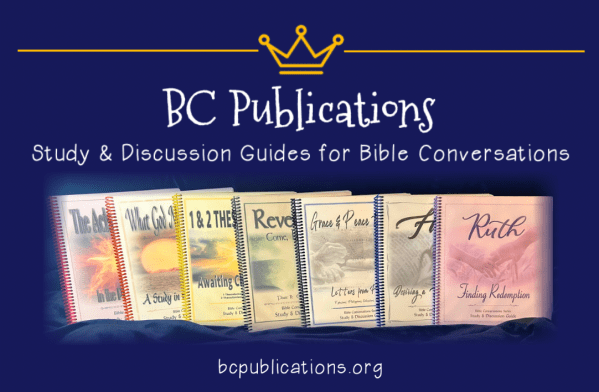
An Inductive Bible Study guide aids in this personal discovery of Truth. Whether you launch your journey with one of our inductive Bible studies in the Bible Conversations Series or use another ministry’s materials, our encouragement to you is to just get started. Every time you sit down to study the Scriptures, pray for a deeper understanding of who God is, and ask why He has recorded what He has for you in His Word. He wants to be known. He desires a more vibrant relationship with you. He wants you to grow in intimacy with Him.
 BC Publications